

A couple of weeks ago, a Substack post sent shockwaves through the stock market.
Not one of my posts, dear reader — though I do appreciate you tuning in.
It was a piece from Citrini Research: a fictional letter written from three years in the future describing an economic crisis triggered by artificial intelligence (AI).
In their imagined 2028, unemployment in the United States has climbed to 10%, and the stock market has fallen by 40%.
The authors admit they’re not certain any of it will actually happen. But the scenario feels uncannily plausible.
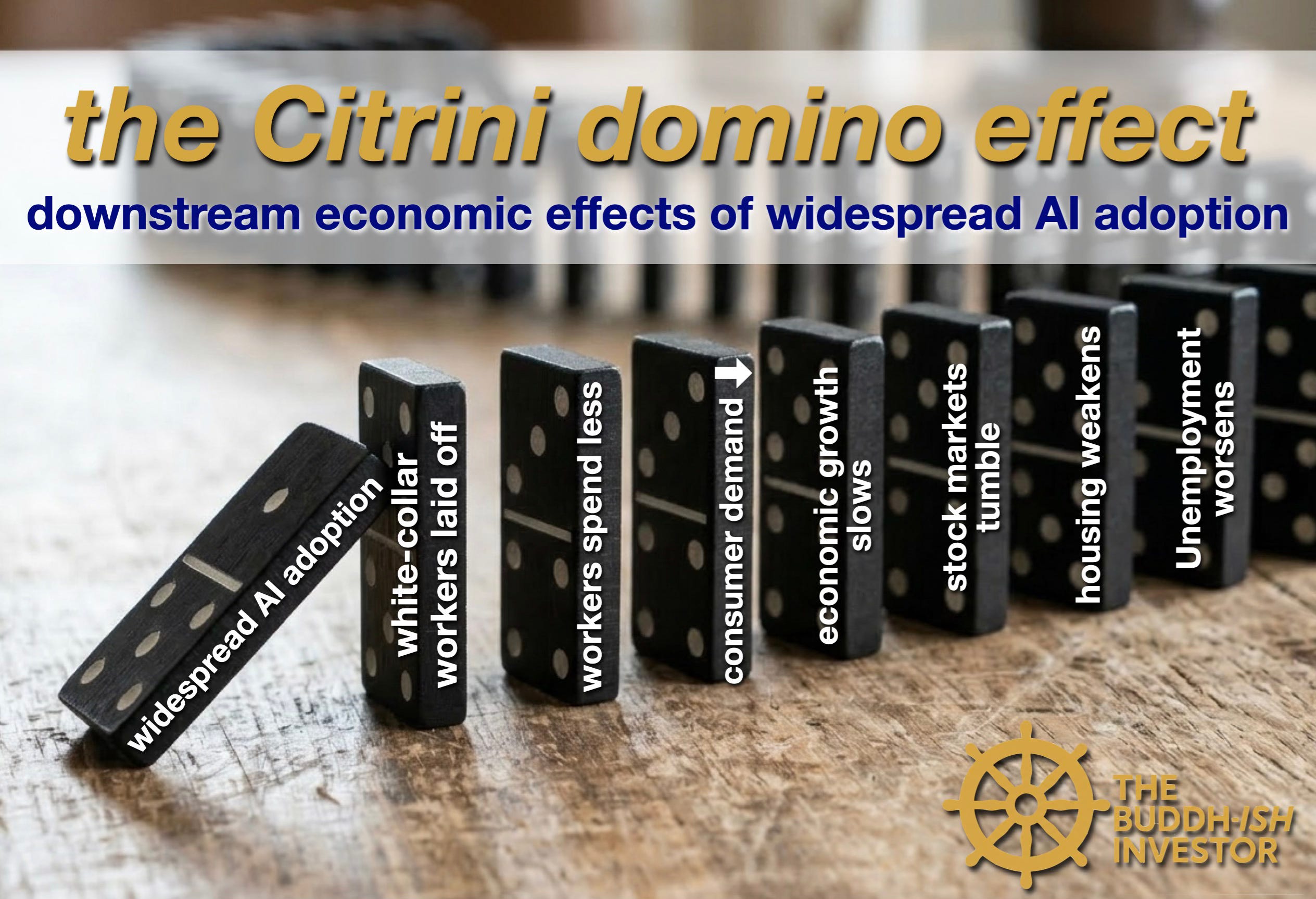
Their argument unfolds as a cascade1:
Widespread adoption of AI
↓
AI replaces large numbers of white-collar workers
↓
Those workers spend less
↓
Consumer demand falls
↓
Economic growth slows
↓
Markets tumble
↓
Housing weakens
↓
Unemployment rises further
One domino knocks over the next, and the next, and the next.
The Citrini essay itself had a domino effect on the market. In the immediate aftermath of its publication, the S&P500 was down 1% and companies named in the report, including Uber, American Express, Mastercard and DoorDash, all lost between 4% and 6%. That’s tens of billions of dollars in value.
The predictions in the essay are striking. But even more striking is the chain reaction it describes — and briefly managed to set off itself.
It points to a deeper truth:
Everything is connected. Nothing arises in isolation.
A war breaks out halfway across the world, and suddenly gasoline prices rise in Toronto2. A central bank decision shifts housing markets. A new technology threatens the livelihoods of people who have never written a line of code.
Interdependence goes both ways
The Buddha spoke about the interconnectivity of our world—or interdependence as it is called in Buddhist circles—in his earliest teachings:
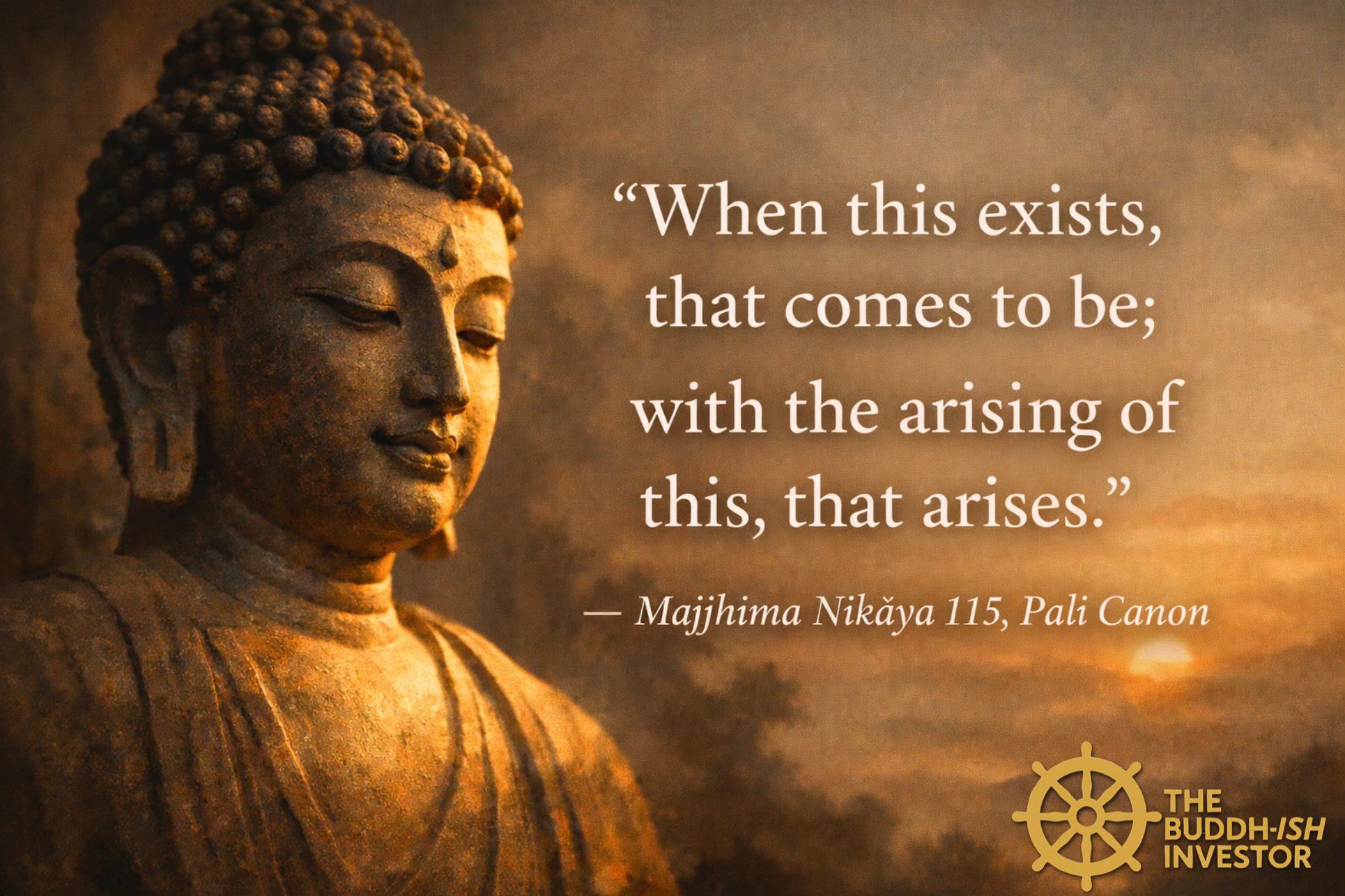
In the intervening three thousand years, our world has become even more interconnected—particularly in the age of global finance, social media, and AI.
And yet, paradoxically, many of us feel increasingly isolated — living more individual, hyper-personalized, me-centric lives.
But there’s no escaping the truth beneath it all.
We can’t live without each other — even if, sometimes, it feels like we can’t live with each other.
We are constantly being shaped by events far beyond the borders of our own lives.
The Citrini piece is simply a dramatic illustration of this reality. A single technological shift sets off a cascade that spreads through economies, markets, and households.
But the truth runs in the other direction too.
Because if the world affects us, then we affect the world as well.
Our choices, our words, our decisions — even the small ones — move outward through the same web of connections. Often in ways we will never see.
A harsh word can travel farther than we intend.
But so can a kind one.
In an interconnected world, nothing we set in motion stops with us.
- The Buddh-ish Investor
I’d love to hear from you! Email at Sangha@TheBuddhishInvestor.com or drop a comment below!
Listen to The Buddh-ish Investor Podcast on Apple Podcasts or Spotify
Follow me on Bluesky: @buddhishinvestor.bsky.social
Take home points:
Everything is interconnected. Small shocks—technological, economic, or geopolitical—can cascade through the global system in unexpected ways.
The influence runs both ways. We’re shaped by the world around us, but our own actions send ripples outward as well.
If you’re looking for more:
Some more Buddh-ish thoughts on interdependence:
Ben and Michael’s thoughtful and very human take on the Citrini article:

Which I have greatly simplified here. For all the gnarly details, please read the original Citrini piece.
A minor inconvenience compared the human tragedy we’re seeing unfold in Iran and Ukraine.