

How do you feel when you look at your retirement account?
Icky?
That’s how Cara Lai feels when she takes a look.
Cara, if you’re not familiar with her work, is a Buddhist teacher and creator of the “Meditate Your Face Off” Substack. She writes and teaches with a delightful blend of insight and irreverence. Highly recommended.
Anyway, her comments about saving and investing for retirement, in a recent podcast appearance, made me do a double-take:
“It just feels really, really icky to me. There’s just such a big part of me that wants to just be like, forget it.”
What’s Cara getting on about?
As an explanation, she said:
“I don’t like it because it feels like I have to participate in this misguided belief that there’s just going to be continuous growth in our market forever. Also, I have to put money towards things that don’t always feel in line with my values.”
I get that. As I’ve discussed in another post, I have my own qualms about fuelling the capitalism machine and owning the many despicable companies that form part of VGRO, the primary holding in my investment accounts.
I’ve made an awkward peace with that. I try to atone for the “sin” of participating in capitalism by using my money and time to improve the world around me—through charitable donations, and by trying to be more present with family and friends.
The Security of a Money Stash
What I have a harder time reconciling is what Cara said next:
“That money that I am investing, it’s money that’s not in the flow, and it could be out there doing things. And it would be so cool if I could just let that money flow in the ways that I want it to flow. And what if we all did that? What if we all started to trust and just give and not have this stash of money somewhere representing our sense of safety? And what if our safety was actually built on generosity?”
I derive a deep sense of security from my investment savings. The future feels less scary because of the stash of money in my TFSA, RRSP and other accounts.
I never really questioned this until hearing Cara’s words.
Now I also feel a little icky.
Here I am hoarding money while people in the world are living in abject poverty.
Why do I do it?
Is it greed? Maybe there’s some of that in there.
Mostly, though, I think it comes down to a lack of trust that the world will take care of me and mine.
My money stash is a salve against a deep lack of faith in humanity and the universe.
That’s a sad thought. A really sad one.
How did it get to this point? I have a good life—probably easier than 95% of the world’s population. I’ve faced little tragedy over the past 40-odd years of life. People are nice to me.
So why am I so distrustful? More importantly, what can I do about it?
A Middle Way
I think there’s something to Cara’s aspirational idea of letting the money flow.
At the same time, I don’t think the answer is to drain my retirement accounts and blindly trust the universe to provide. Cara ultimately lands here too. As much as she’d like to let the cash flow, she has kids to provide for and bills to pay. I have the same responsibilities in my life.
Buddhism often points toward a middle way rather than extremes. And maybe there’s a middle path here too: preparing responsibly for the future without turning money into my sole source of safety and reassurance.
I donate money to charity on a regular basis. I buy gifts for the people in my life. These acts of generosity only add up to a small percentage of my net worth. Probably less than 1%.
Giving more seems reckless to me—with bills to pay and a future to secure for myself and my family. But maybe I’m going about it all wrong.
Maybe the hoarding just reinforces the distrust. I think I’m building security, but I’m really just investing in insecurity.
Charitable Reps, Not Flexes
Perhaps it’s time for some radical generosity. Give more than I feel comfortable giving.
Not in some performative, billionaire-philanthropist “flex” kind of way—“Oh, look at me: I’m so rich, I can donate $1,000,000 to this charity.”
That’s one way to approach charity. Whatever the ulterior motive behind it, the money’s still flowing.
Another way to look at charitable acts is as “reps” toward building up one’s trust muscles. Not a flex, but a rep.
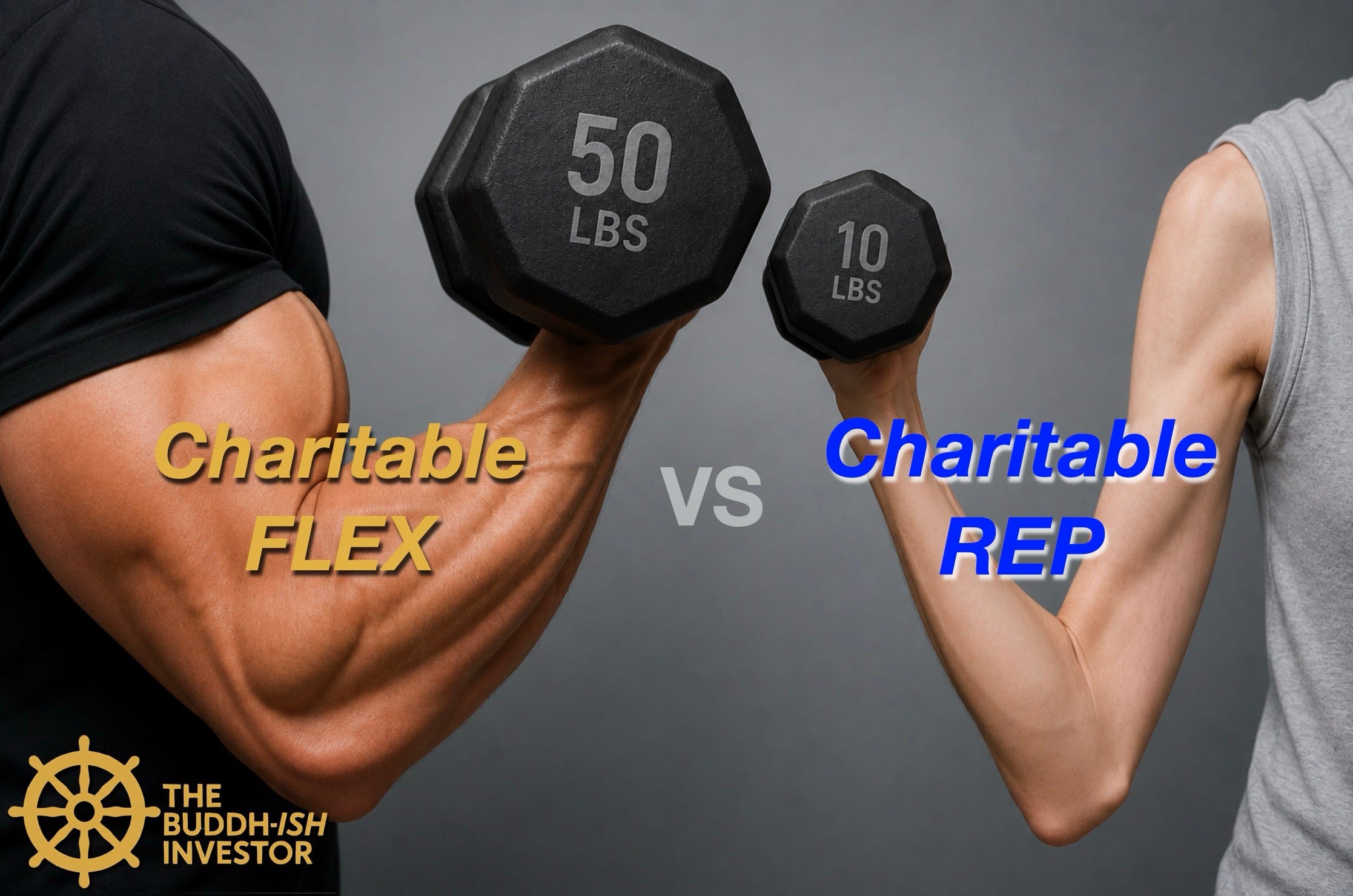
Enough to challenge the part of me that believes security can only come from accumulation.
The next question is: How much to give? Some folks, particularly those of the Effective Altruism persuasion, allocate a certain amount of their income—5, 10 or more percent—to charitable giving. That’s a potential starting point.
I don’t know if I’m quite ready to donate a non-trivial percentage of my income to charity. Or to be that precise about it.
I think it’s enough to push the limits of my comfort on giving. When I get the urge to be generous, just give without thinking too hard about it. And give a little more than whatever my first instinct is.
All this giving might mean that my retirement account doesn’t grow as much as I’m accustomed to.
But maybe I’ll feel a little less icky about it all. Maybe even a little richer.
- The Buddh-ish Investor
I’d love to hear from you! Email at Sangha@TheBuddhishInvestor.com or drop a comment below!
Listen to The Buddh-ish Investor Podcast on Apple Podcasts or Spotify
Follow me on Bluesky: @buddhishinvestor.bsky.social
Take home points
Retirement savings can provide a sense of security, but may also reflect an underlying lack of trust in the world.
A middle path might involve saving responsibly while practicing greater generosity as a way of loosening fear and building trust.
If you’re looking for more
A great guided meditation from Cara on reorienting your relationship with money:
More on dealing with investing ickiness:
Can You Be a Good Person With a Bad Portfolio?
·
I own a bunch of companies with dubious track records for good behaviour:


I know I’m late to the party but I don’t understand the framing of the dilemma. I can’t think of anything more optimistic than owning a minority stake in a business and hoping they continue create goods and services valued by yet another set of strangers.
I’m not commenting on charity as I think that is a prerequisite for “doing things right”
I guess I was just really shocked by the idea that owning business and loaning businesses funds was somehow hoarded, stagnant wealth. I reserve that classification vacant apartments owned in global cities