

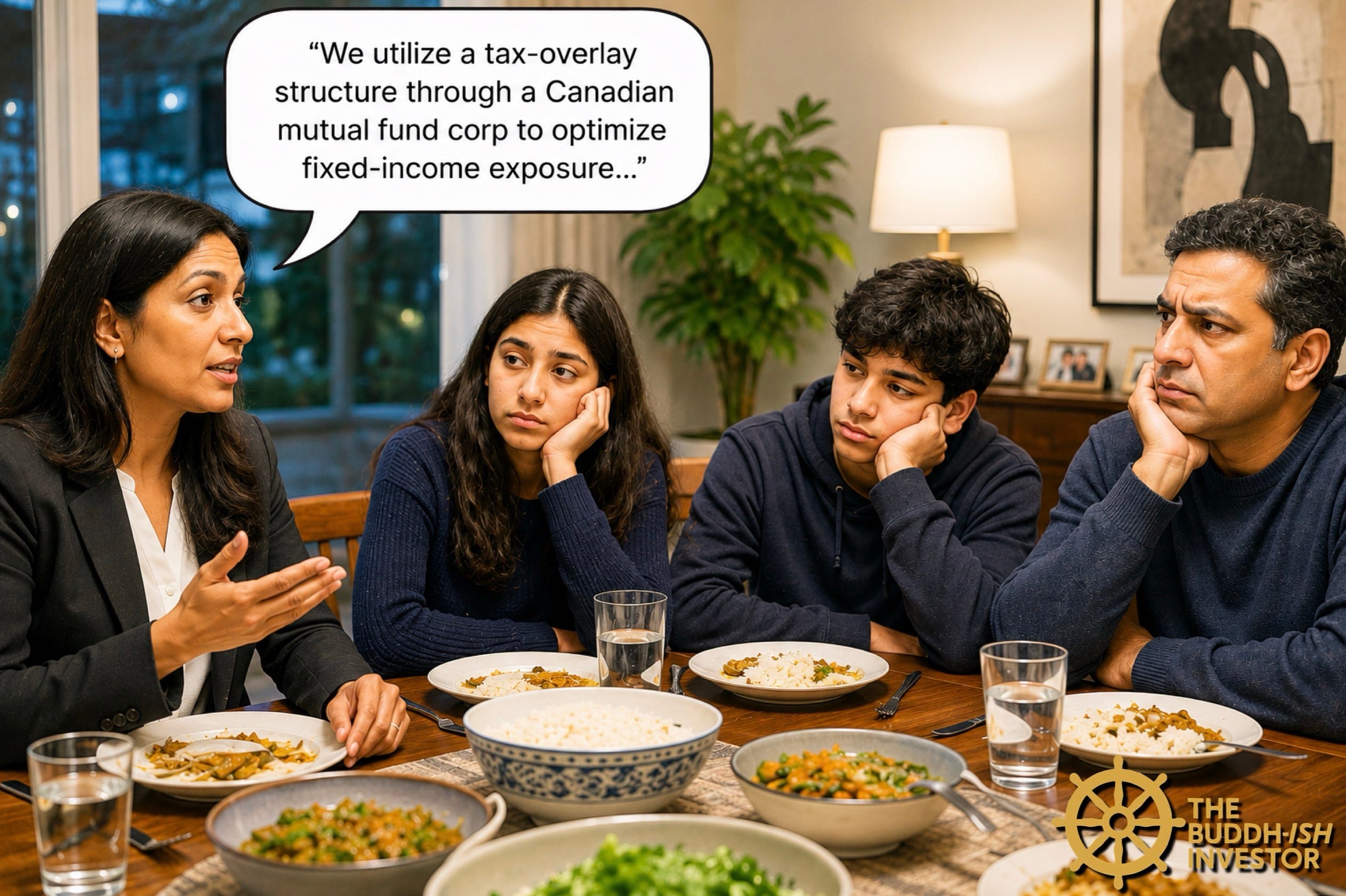
“We utilize a tax-overlay structure through a Canadian mutual fund corp to optimize fixed-income exposure by flowing losses across the portfolio and converting interest-income distributions into a more capital-gains-oriented tax profile.”
Huh? Come again?
That head-scratcher of a sentence came verbatim from a recent conversation I had with some investment advisors at a Canadian Big Bank. The entire conversation, beyond the initial pleasantries, felt like that. At times, I genuinely had no idea what they were talking about.
Granted, I’m not an investment professional. But I spend a lot of time reading and thinking and writing about investing. So it was a strange feeling to sit there struggling to follow the conversation. I left feeling frustrated, but also a little bit… inadequate.
I went for a run afterward to clear my head and listened to an episode of Dave Chilton’s The Wealthy Barber Podcast.
It was exactly the antidote I needed.
Dave has spent decades trying to demystify finance for ordinary people. No posturing. No needless complexity. Just clear and relatable language.
I first read Dave’s seminal book The Wealthy Barber as a kid on my dad’s recommendation. I honestly don’t remember much of the book now, but I’m sure it helped nudge me down the path I eventually went down.
From there, I found the Canadian Couch Potato blog, then Rob Carrick’s stuff, then podcasts like Rational Reminder and BeyondMD and a long list of other people trying to make the investing/finance world feel a little less intimidating to ordinary people like myself.
I value people like that enormously.
Because investing is intimidating enough already.
Buddhism can be the same way.
A Foothold
The first time I dipped my toes into Buddhism, it felt impossibly foreign to me. Endless unfamiliar terms and concepts and schools and traditions: Dependent Origination, the Five Aggregates, non-self, emptiness, samsara, kalyanmitra.
I could easily have decided it just wasn’t for me.
But then late one night, over a bowl of cereal, I stumbled across Noah Rasheta’s Secular Buddhism Podcast. Noah explained Buddhist concepts in a way that suddenly felt practical and relatable to my everyday life.
Suddenly, I had a foothold.
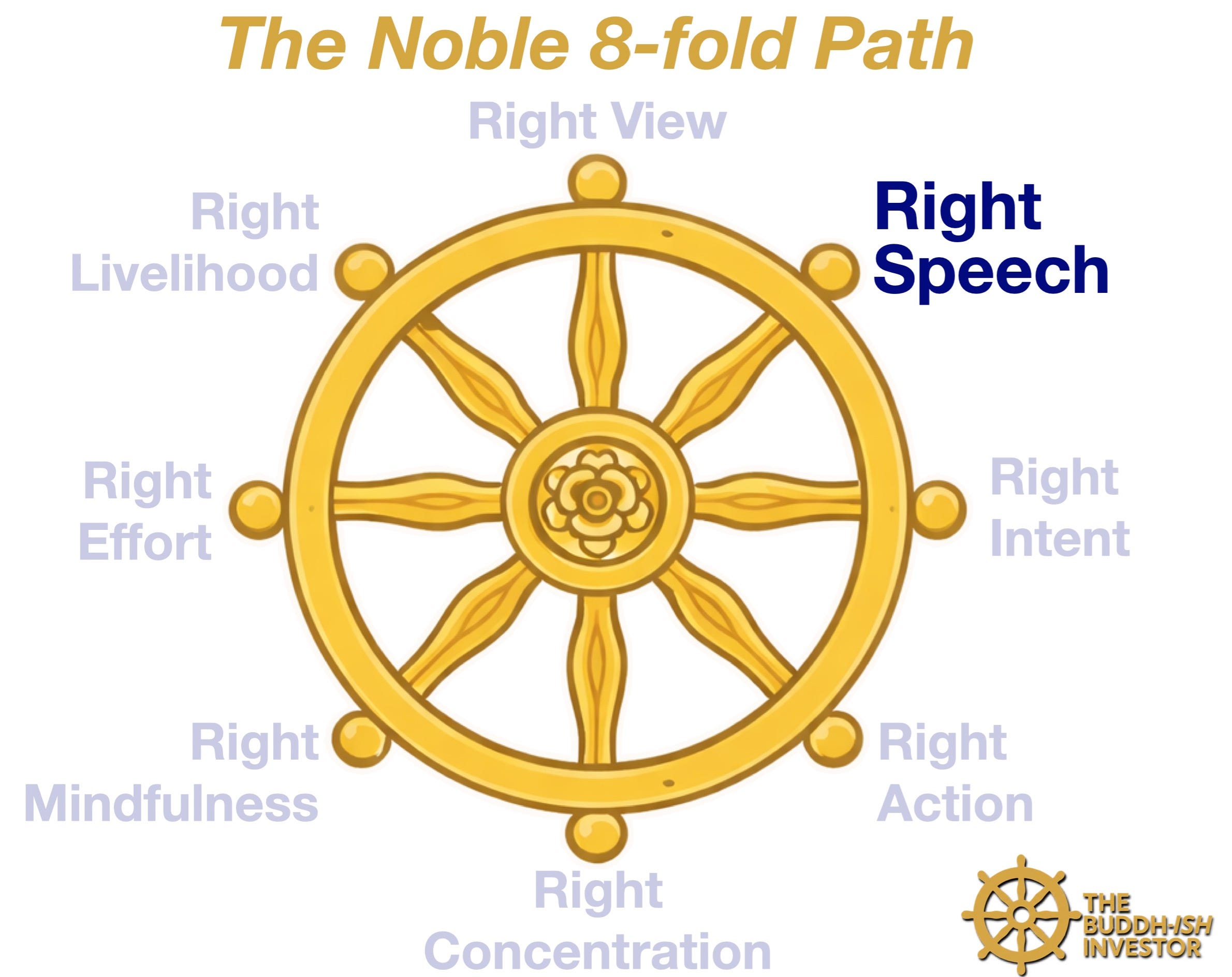
That’s been making me think lately about the Buddhist idea of right speech. Right speech isn’t just about avoiding cruelty or lying or being pleasant all the time. At its core, I think it asks us to consider the effect our words have on another person. Are we helping them understand? Or are we leaving them feeling confused and diminished?
Right Speech
I don’t think those investment advisors were bad people. And maybe the jargon wasn’t intentional at all. Maybe they’ve simply spent so long immersed in that world that they no longer hear how opaque it sounds from the outside. Maybe they talk like that at the dinner table.
But the conversation stayed with me because it made me reflect on the ways I probably do the exact same thing in my own life.
I work in a field with plenty of its own jargon and shorthand. And when I’m talking to colleagues, the jargon flows freely. It is a remarkably efficient way to discuss ideas.
But to someone on the outside, it must seem like we’re talking Klingon.
Just like “capital-gains-oriented tax profile” sounded to me in that meeting.
Over the last few days, I’ve caught myself thinking more carefully about the words I use when talking to other people — the moments where I instinctively reach for technical language instead of just speaking plainly.
Sometimes that language probably does come from efficiency. But other times, if I’m being honest, it comes from wanting to sound knowledgeable.
Or even to make the other person feel less knowledgeable.
Our words can be weapons or bridges. Right speech encourages us to ask ourselves how we’re using them. Are we speaking to be heard? To help the other person? To hurt them?
And if you don’t know the answer to those questions, try asking the other person.
- The Buddh-ish Investor
I’d love to hear from you! Email at Sangha@TheBuddhishInvestor.com or drop a comment below!
Listen to The Buddh-ish Investor Podcast on Apple Podcasts or Spotify
Follow me on Bluesky: @buddhishinvestor.bsky.social
Take home points
Jargon can make investing and Buddhism feel intimidating and exclusionary to outsiders.
“Right speech” asks us to consider whether our words are helping others feel understood—or creating distance between us.
If you’re looking for more
Check out this particularly insightful—and jargon-free—episode of The Wealthy Barber Podcast in which Dave talks to financial advisor Mark McGrath about his bold decision to put family before work:
Your post caused me to reflect on right speech and headed me down a rabbit trail, not so much on jargon but on my conversations with two parents with Alzheimer's dementia. Noah Rasheta is probably the best modern communicator on secular Buddhism and like you, his non-jargon explanations made the Eightfold Path approachable for me. Instead of "Right", Noah prefers the word "skillful". Skillful speech makes sense to me. Skillful speech decreases suffering or discomfort.
Where this became difficult for me is the Buddhist teaching of the Four Gates of Right Speech: Is it truthful, necessary, kind, and timely? Well, with dementia, the loved one often thinks they are living somewhere they are not. My dad will say, "I've lived here in Denver for most of my life." We're not living in Denver. Alzheimer's experts advise not correcting the individual in conversations, as it simply confuses them and causes anxiety. Yet, the first gate is be truthful...don't lie. Dang, now what do I do?
Noah unpacks "truth" into three types: Objective, Subjective and Shared. For dad, his subjective truth is Denver. Knocking him over the head with the Objective truth (Dad, we don't live in Denver anymore) increases his suffering and does nothing to improve the situation. The more skillful speech is to go with it, like in improv comedy, with the "yes, and..." approach. "Yes, and you always worked so hard in Denver, didn't you. What was your favorite project?" More skillful and doesn't disrespect his subjective reality and causes more suffering.
Anyway, thanks for the trigger to think and reflect this morning. The Eightfold Path is an incredible operating manual for today's living, once the jargon is unpacked.