

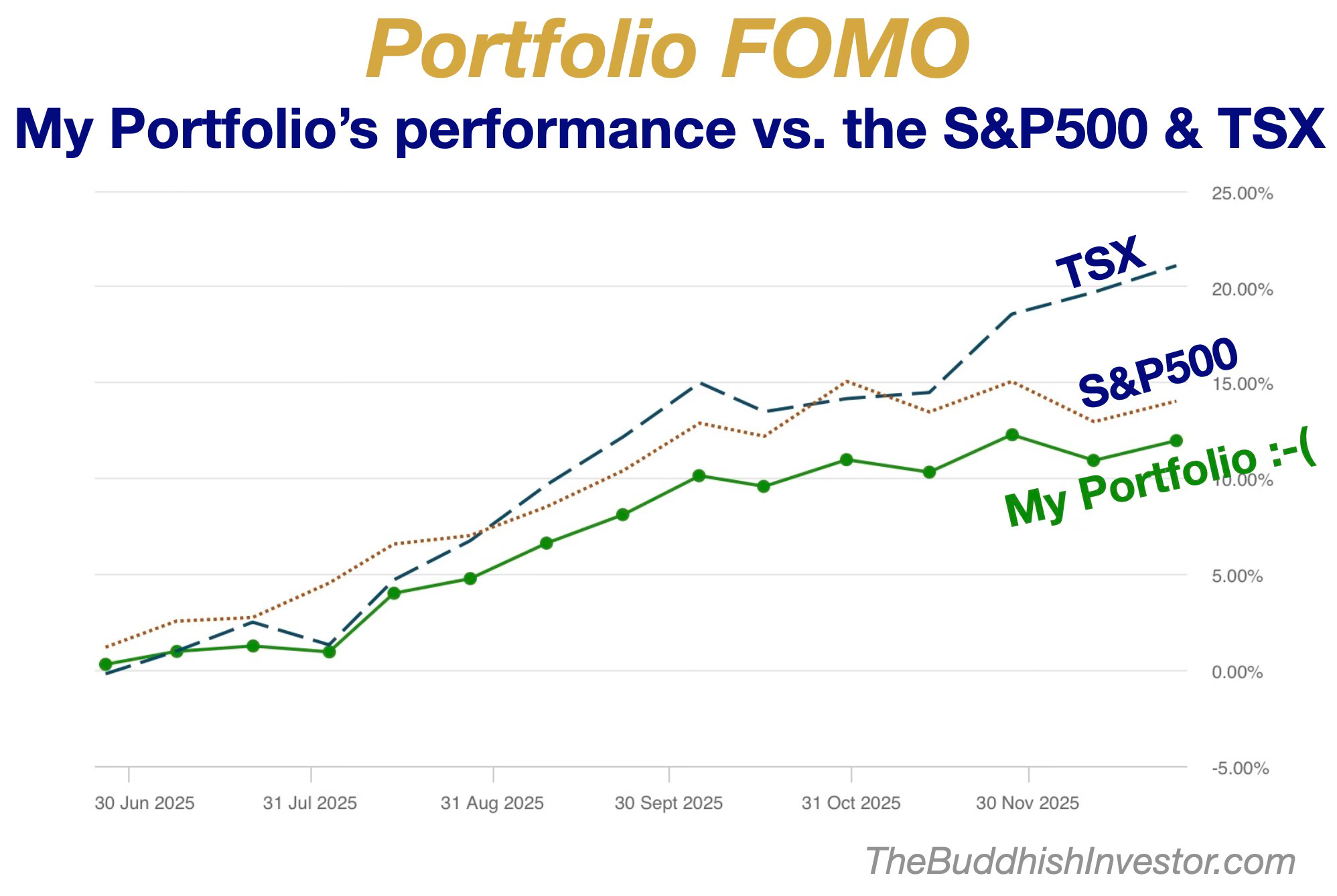
This is what greets me every time I log in to my brokerage account:
Humbling.
Over the past six months, my portfolio has underperformed both indices1—by a pretty good margin, too.
My first thought is obvious: “What am I doing wrong?”
That thought quickly multiplies:
“Shouldn’t I at least be matching the market?”
“Should I ditch my tried-and-true VGRO and just buy the S&P 500 and the TSX outright?”
“Am I selling myself short?”
Then I try to talk myself off the ledge:
“It’s only six months. Wealth is built over decades, not months.”
“You want diversification—global equities and fixed income—not just Canada and the U.S.”
Eventually, as my mind eases, a different set of questions emerges:
“Why am I even comparing my portfolio to the S&P 500 and the TSX in the first place?”
“And who decided that I should be forced to look at this comparison every single time I log in?”
Surely not me.
Once I tumble down that rabbit hole, it’s hard not to get a little suspicious. Is this chart really here to help me? Or is it designed to cultivate just enough discomfort—just enough FOMO—to nudge me into trading more often and generating revenue for someone else?
After that brief conspiracy spiral runs its course, I look back at my portfolio, realize there’s nothing for me to do, and go on with my day.
Which raises another uncomfortable question:
Why do I even check my brokerage account anymore?
I’m not day-trading. I’ll sometimes go weeks without making a single trade. Vanguard keeps my portfolio neatly rebalanced at 80% stocks and 20% fixed income. There’s no lever for me to pull.
And yet, not checking feels irresponsible.
If I’m not watching my portfolio, I might miss something.
If I’m not paying attention, I might fall behind.
Behind the market.
Behind my peers.
Behind my goals and dreams.
FOMO hums quietly beneath it all.
The investing industry understands this about the human brain—and it exploits it. It churns out expensive products for every new investing fad2, confident that many people would rather chase the next opportunity than risk missing out.
I think that chart serves the same function.
Its job isn’t to inform me. It’s to keep me comparing.
FOMO & The Comparison Trap
Because even if my portfolio were outperforming the S&P 500 and the TSX, I wouldn’t suddenly feel at peace. I’d worry about staying ahead. I’d wonder how long the streak would last. I’d look for the next thing to beat.
In that sense, comparison—whether to market indices or to other people—is a remarkably reliable source of suffering.
We’re either falling short of expectations, or we’re anxious about losing what we have.
So what’s the solution? Just stop comparing?
Easier said than done.
Comparison is an innate feature of the human brain. It’s an unavoidable byproduct of being social creatures. Without it, we wouldn’t function very well at all.
But we can work with it.
We can notice when comparison is quietly shaping our sense of worth.
We can limit exposure to systems—like social media—that profit directly from FOMO.
And if we’re going to compare, we can be far more thoughtful about what we compare ourselves to.
Just because Drake drives a Bentley doesn’t mean I should be driving one.
Just because a coworker gets to work from home on Mondays doesn’t mean that I should too.
And just because the TSX is up 20% over six months doesn’t mean I’m falling behind if my globally diversified, balanced portfolio is only up 12%.
My portfolio was never designed to beat an all-equity Canadian or U.S. index. It was designed to support a specific life, with a specific tolerance for risk, volatility, and uncertainty.
Comparing my portfolio to the wrong benchmark doesn’t make me a bad investor—it just guarantees dissatisfaction.
When we’re in the grip of FOMO, we tend to look for happiness in the wrong places. We tell ourselves we’ll be content once we get the next toy, the nicer car, or the better-performing portfolio.
And if we do get it, the bar quietly moves.
Now we’re comparing ourselves to the next rung up.
The next benchmark.
The next chart.
It never ends.
Right View & Portfolio FOMO
The Buddha understood this dynamic more than 2,600 years ago. He taught that much of our suffering comes not from our circumstances, but from how we misunderstand them. FOMO is a misunderstanding of where happiness actually comes from.
In the Eightfold Path, the Buddha begins with Right View—seeing reality as it actually is.
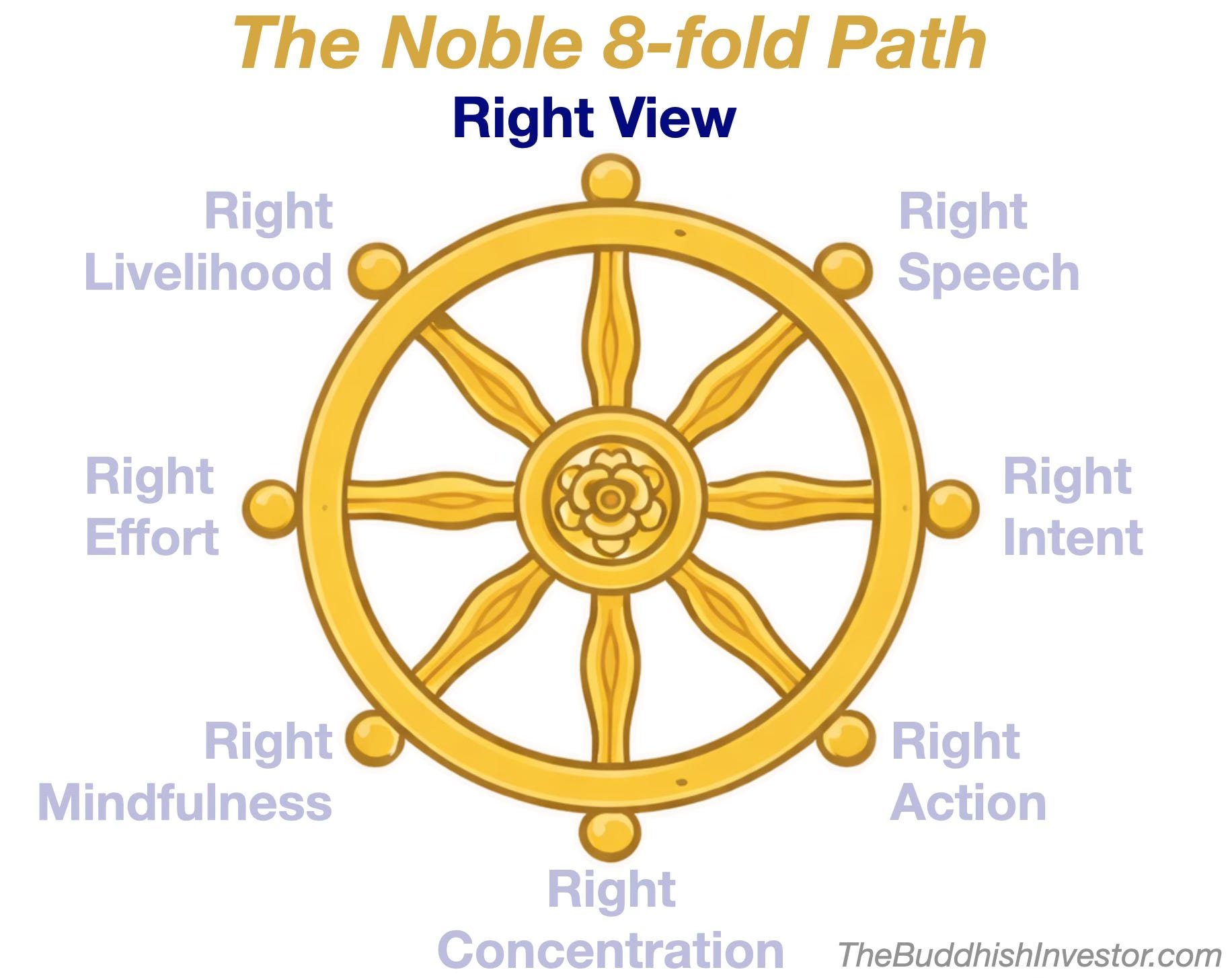
Right View asks us to question the stories our minds are telling us. It asks whether happiness really comes from new toys or from comparing ourselves to others.
I think most of us understand, at least intuitively, that neither of those leads to lasting peace or contentment.
But it’s easy to forget this when we’re in the grip of FOMO, like when I see that cursed chart every time I open my brokerage account.
That’s why I’ve set some rules around checking my portfolio:
A Practice: Rules for dealing with portfolio FOMO
Don’t log in to your investing account unless you’re prepared to make no changes. If I already know I won’t change anything, logging in is usually curiosity dressed up as responsibility.
Don’t judge long-term decisions by short-term results. A diversified, balanced portfolio will underperform something most of the time. That’s not a mistake—it’s the trade-off.
Don’t compare your portfolio to benchmarks it wasn’t designed to beat. An 80/20 portfolio shouldn’t be competing with an all-equity index. They’re playing different games.
Only make portfolio changes when your life changes. New goals, a different timeline, or a real shift in risk tolerance—those are reasons to act. Market noise isn’t.
When the feeling of “falling behind” shows up, pause. Then remind yourself what this portfolio is for. Not to win—but to support a life you already find meaningful.
Try them out if you’re dealing with portfolio FOMO.
And consider making similar rules of engagement around other sources of FOMO in your life, like social media or real estate listings.
Even if you don’t follow the rules perfectly, the act of setting them is still useful. It’s a way of seeing your situation more clearly—with Right View—and a small step down the path toward inner peace.
- The Buddh-ish Investor
I’d love to hear from you! Email at Sangha@TheBuddhishInvestor.com or drop a comment below!
Take home points:
FOMO and comparison are reliable ways to make ourselves miserable.
A good portfolio can still feel bad when it’s measured against the wrong benchmark.
If you’re feeling portfolio FOMO, try the “Rules for dealing with portfolio FOMO” above
If you’re looking for more:
Oliver Burkeman on JOMO—the JOY of missing out
The Buddh-ish Investor’s collection of favourite Buddh-ish quotes: MyDailyBuddha.com
“Indices” is plural for index (just like “matrices” is the plural of “matrix.”) An index is a market yardstick that tracks a specific basket of stocks, bonds, etc. The S&P500, probably the mostly common index mentioned on this blog, is a stock market index that tracks the performance of 500 of the largest publicly traded companies in the United States. The TSX is the Canadian equivalent.
To name a few recent fads: Meme stocks, thematic ETFs, leveraged ETFs, smart beta, etc.